Wednesday, January 22, 2014

Bank of Canada Interest Rate Announcement

The Bank of Canada announced this morning that it is maintaining its target for the overnight rate at 1 per cent.  In its statement, the Bank once again highlighted that inflation remains stubbornly below the Bank's 2 per cent target due to significant excess supply in the Canadian economy, as well as heightened competition in the retail sector.  The Bank now see inflation returning to target in about 2 years as the effects of retail competition dissipate and excess capacity is absorbed through faster economic growth. In its concluding paragraph, the Bank notes that although the fundamental drivers of inflation appear to be strengthening, inflation remains below target and downside risk to inflation have grown in importance. Most importantly, the Bank notes that the timing and direction of the next change in interest rates will depend on how new information influences the balance of risk between low inflation and elevated household imbalances.

There has been substantial speculation of late that if inflation remains near the bottom of the Bank of Canada’s 1-3 per cent control range over the next six months, then the next move by the Bank will be a rate cut rather than the rate-hike most economists have penciled into forecasts.  Indeed, the Bank’s messaging and guidance has been much more dovish of late, essentially reversing the unequivocal tightening bias at the Bank under Mark Carney.  The macroeconomic impact of the change in messaging is significant, prompting both a decline in long-term interest rates as well as a substantial decline in the dollar.  A result that is both welcome to a slow-growing Canadian economy as well as very likely engineered by policymakers. While we are not in the rate-cut camp (though that outcome is far more likely that it was six months ago), particularly with economic growth in the global economy set to dramatically improve, we believe that an eventual rate tightening is still far out on the horizon.

Copyright BCREA – reprinted with permission 

Tuesday, January 21, 2014

Monday, January 20, 2014

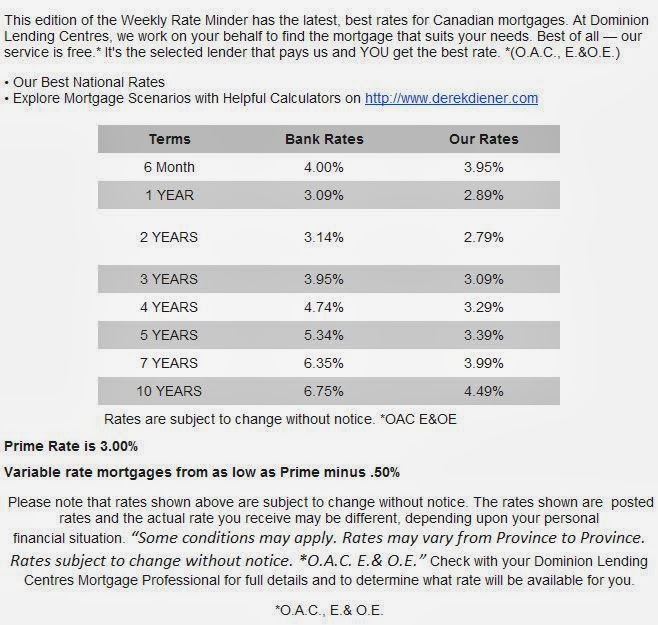
Best Rates


Wednesday, January 15, 2014

Home sales up 13% in December from year ago, down for month

The number of existing homes that changed hands in Canada in December was nearly 13-per-cent higher than a year earlier, but slipped from the prior month for the third time in a row.

Sales over the Multiple Listing Service last month were 1.8-per-cent lower than in November on a seasonally-adjusted basis, according to the Canadian Real Estate Association, which represents the majority of real estate agents in Canada. They have been declining month-to-month since September.

But the 12.9-per-cent year-over-year increase exceeded expectations of some economists. Bank of Montreal’s Sal Guatieri had been looking for a 7-per-cent gain from December 2012. About 70 per cent of all Canadian markets had more sales last month than they had a year earlier, with the strongest gains coming from Vancouver, the Fraser Valley, Calgary, Edmonton, Toronto and the Hamilton-Burlington area.

The average price of homes that sold over the MLS, meanwhile, was up by 10.4 per cent from a year earlier to $389,119. Averages can be distorted by changes in the location or size of homes that are selling, and the real estate association says that most of the increase was driven by the rebounding markets of Vancouver and Toronto. When those two cities are removed, the average increased by only 4.6 per cent.

The MLS Home Price Index, which attempts to create a more apples-to-apples national comparison, was up 4.3 per cent. That’s a slight acceleration in price growth from the 4.11 per cent annual gain registered in November.

The number of homes that changed hands during all of 2013, at 457,893, was 0.8 per cent higher than in 2012. At the start of 2013, economists were expecting home sales to drop from the prior year, as the market was still in the midst of a slump that began after Finance Minister Jim Flaherty tightened mortgage insurance rules in the summer of 2012.

If the government doesn’t tighten rules further, then this year’s sales could surpass those of 2013, assuming demand holds steady and that a strengthening economy and job gains offset expected small increases in mortgage rates, said CREA’s chief economist Gregory Klump.

On a month-to-month basis, sales were down in about 60 per cent of local markets, including Calgary, Edmonton and Toronto, CREA said.

The number of new listings, which was down 4.3 per cent from November, fell further than sales, pushing the sales-to-new listings ratio to 55 per cent from 53.6 per cent.

“This indicates a slightly firmer housing market but remains well within balanced territory marked by the range from 40 to 60 per cent, as has been the case since early 2010,” CREA said.

TARA PERKINS - REAL ESTATE REPORTER

The Globe and Mail

Monday, January 13, 2014

Rate Reminder


BC Home Sales Bounce Back in 2013

The British Columbia Real Estate Association (BCREA) reports that a total of 72,936 residential sales were recorded by the Multiple Listing Service® (MLS®) in BC during 2013, up 7.8 per cent from 2012. The five-year average is 75,400 units, while the ten-year average is 84,800 units. Total sales dollar volume was $39.2 billion, an increase of 12.6 per cent compared to 2012. The average annual MLS® residential price in the province rose to $537,414 last year, up 4.4 per cent from 2012.

"After declining nearly 12 per cent in 2012, home sales posted steady growth through last year,” said Cameron Muir, BCREA Chief Economist. “Greater Vancouver, Kamloops and Okanagan Mainline board areas posted the most significant changes, with home sales rising between 12.5 and 14 per cent. Stronger consumer demand combined with fewer homes listed for sale improved market conditions in most regions last year."

In December, BC residential unit sales rose 47 per cent to 4,426 units, compared to December 2012. Total dollar volume was 67.7 per cent higher at $2.5 billion, while the average MLS® residential price rose 14.1 per cent to $568,416.

"Large year-over-year changes in December reflect relatively weak activity the previous year rather than evidence of an accelerating market,” added Muir.


Copyright BCREA – reprinted with permission 

Canadian and US Employment

The Canadian economy finished the year on a weak note with total employment falling by 46,000 jobs in December. Those job losses pushed the Canadian unemployment higher by 0.3 points to 7.2 per cent. For all of 2013, employment growth averaged a mediocre 8,500 jobs per month and total employment expanded 1.3 per cent over 2012. Weak job growth and very low inflation in the Canadian economy should further erode any remaining rate-tightening bias at the Bank of Canada.

In BC, employment growth finished the year on a more positive note, with 12,500 new jobs. Unfortunately, job gains were isolated to part-time work and the province continued to lose full-time jobs. The provincial unemployment rate fell 0.1 points to 6.6 per cent. Total employment finished 2013 down 0.2 per cent from 2012.

In the United States, jobs gains missed markedly to the downside, posting just 74,000 new jobs versus expectations of 200,000. Despite weak job growth in December, the US unemployment rate fell to a five-year low of 6.7 per cent as a result of fewer people actively looking for work. However, monthly non-farm payrolls have averaged a relatively robust 174,000 jobs over the past three months which may provide a better guide to the underlying trend in unemployment.


Copyright BCREA – reprinted with permission 

Thursday, January 9, 2014